RPG Maker Dungeon #16: Three the Hard Way
Link: http://www.queenscourt.org/games.php?GameID=6
Three the Hard Way makes a bad first impression. It begins with a prologue describing humanity's battle against the Kaibutsu (which means "monster" in Japanese.) In order to defeat them, the hero Carolus goes to find their source, with the help of his magic sword Kibou (which means "hope" in Japanese.) He learns to his horror that his sister Olanta was behind it all. "The power," she cries, as her brother draws his sword. "I can't believe the power!" Speaking for myself, I couldn't believe the game's gratuitous use of Japanese.
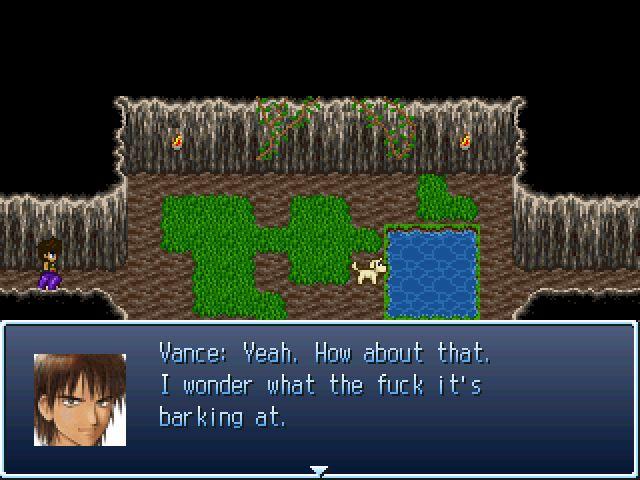
The next section of the game is better. Sixty-five years later, our real protagonist is not Carolus, but Vance--a selfish guy in the sticks who wants a well-paying job that will let him move out of his dad's bar. Instead of a magical sword, he starts with a switchblade that's "good for skinning cats _;". "Okay, Three the Hard Way," I thought, "you have my attention." But then the first level follows a Lost Woods puzzle with a boss that can poison you, at a point in the game where you have very few options or antidotes. I figure most folks playing today would give up on the game there and then.
Despite its early lack of polish, Three the Hard Way is one of the most beloved games to come out of the early English language community. It is longer and more complex than nearly every other game from the scene in that time period. The developer iishenron was a pillar of the community who founded the Misao Awards, meant to honor games made in the RPG Maker engine. Three the Hard Way is a showcase for what is possible even in an antiquated engine like RPG Maker 2000: it has custom menus, minigames and a level-up system that operates on an encounter basis rather than by EXP.
Not all of those innovations hold up today. The minigames help break up the experience, but are often cumbersome and occasionally broken. The level-up system keeps your characters from becoming too powerful, but doesn't do much to remove grinding from the equation. Meanwhile, skills are mostly useless, and your inventory is determined by whether iishenron remembered to include enemies in an area that drop crafting materials. Don't expect to buy a Tonic from the local store unless you have enough Hardened Slimes on hand.
In other respects, though, Three the Hard Way shows real thought in its construction. Vance's progression for instance. Every night he visits the seedy tavern by his best friend North's place to pick up jobs. Slowly but surely he grows from a nobody to a resourceful bounty hunter. Meanwhile, we see the horrors of the past creeping back into the world: werewolves stealing sheep, monster lizards in the sewers. It's a Trails-style slow build but with a cast of ne'er-do-wells instead of Boy Scouts.
The game's best quests have the roller coaster pacing of a Final Fantasy set-piece and the variety and scope of a tabletop module. At any point you might find yourself saving a pop star from a dragon, escaping a desert island or infiltrating a party. Quests also differ depending on when you do them, and even branch according to your choices.
Later in the game you are given the objective of killing the dangerous Duke Greene, but have the choice of three routes. Do you pay for a boat ride, bribe an official to ambush Greene at his vacation home, or cross the mountains yourself? You can play the game two or three times and still find new permutations. That is no small feat for a freeware RPG of this vintage, much less a complete game.
Three the Hard Way cannot help but be marked by that vintage. Not just in terms of the casual misogyny and transphobia that pops up once in a while. But in the game's signifiers: emoticons in dialogue, references to other RPG Maker games, political cynicism that may very well be in response to the Bush presidency as well as the Iraq War. No matter how hard iishenron fights to escape the limitations of RPG Maker, his game for better or worse bears the mark of that community at a specific time and place.
That's also why I find it so charming. Three the Hard Way is a great showcase for what hobbyist game communities are all about: building an experience for your friends within limitations and without compromise. Its strengths are buried deep enough that players without the context or patience to recognize them will be left wanting. As for me in the present day, though, I note the developer's choices and think, "I see you."